


LG Announces Big Investment in Solar, following Samsung


| 26 September 2011
Posted in News - SPVI news
LG is expecting to become a global leader by 2015.
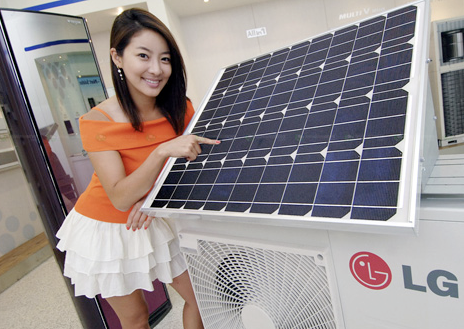 LG revealed plans to become fully invested in the solar value chain by 2015. LG has already dedicated $455M into a polysilicon plant to be completed by 2014. Its flagship company, LG Electronics, will expand solar manufacturing from its current level of 300 megawatts (MW) to 1,000 megawatts by 2014 by spending additional $391M.LG is expecting to become a global leader by 2015.
Another South Korean conglomerate Samsung, announced recently that global market for solar cells is anticipated to double by 2020 to $70B, and the company is planning to join the movement. Global solar market is currently dominated by Chinese companies, which are low cost, producers of high-quality modules. Samsung plans are to grow its current 150MW production to 3GW by 2015 in cell capacity. "Our super-efficient crystalline solar cells will differentiate us from our competitors, while we build our portfolio in thin-film products," said Choi Chang-sik, executive vice-president of the company's solar-energy division, in the recent interview with Reuters. According to Mr. Choi solar was selected as one of the five future Samsung growth engines in May 2010, and the business has achieved the world-leading technology with its focus on R&D in a short period of time. Samsung has produced modules with 18.5% efficiency, which is a top class based on SP (Screen Printing) technology and developed a higher efficiency module with 19% cells ready for sales in a later part of 2011.
In addition, Samsung achieved the world record R&D efficiency level of 20.2% based only on SP technology. This is the world record based on the 6-inch wafer which beats the previous record at 19.6% made in April of this year by Bosch. Samsung has achieved high-efficiency in technology areas as BC (Back Contact) and HIT (Hetero-junction Intrinsic Thin-layer). In BC, Samsung achieved 21% efficiency within 1.5 years of testing. SunPower is the record holder at 23% on 6 inch wafer. In HIT, Samsung achieved 20.7%, for the first time beating Sanyo 20% 5-inch commercial cell. High efficiency solar modules such as BC and HIT are normally based on the 5-inch wafer. In this regard, over 20% efficiency based on the 6-inch wafer whose size is 40% bigger compared to 5 inches is being considered as a big technology achievement. However, Chinese companies like Trina, Yingli and recently Canadian Solar, have announced high conversion, high-output modules, on cheaper platforms than monocrystalline cells.
Canadian's new ELPS technology is based on the metal-wrap-through (MWT) architecture where the front-side electrode is moved to the back. Moving the electrical connections to the back allows more of the front surface to become exposed to sunlight, resulting in a significant efficiency increase. At the module level, ELPS allows interconnection on one side, which reduces module series resistance and increases the fill factor, resulting in higher power output. Moncrystalline cells in such a module had recorded 19.5% conversion and output of 265 watts. The module conversion rate was recorded at 16.47%. Canadian has also quasi mono cell modules built with MWT technology. Trina had achieved even better result with its multicrystalline cells. In the laboratory, module built with "honey" cells using string ribbon technology delivered 275 W with conversion 16.9%, which is the highest multi cell module output to date. Chinese companies are not only leading in capacity but also in technological development and not ready to give up any market share. In February, Samsung SDI's sister company Samsung Fine Chemicals agreed to set up a joint venture with U.S. solar wafer maker MEMC Electronic to produce polysilicon, a key material to make solar wafers. The joint venture plant would produce 10,000 MT of polysilicon per annum. The size of the joint venture's investment is estimated at $1B or Capex cost of $100 per kg of polysilicon.
Despite pressures on average selling prices within the supply chain, larger enterprises, particularly Asia based, are negotiating their way to enter solar markets. Other Korean companies have plans or have entered the solar market. Those include LG, Hanwha, Hyundai,OCI as well as smaller KCC, LYC. In first half of the year Chinese US listed companies had sold over 4.9GW of modules, on average increasing sales by 34% versus 2010. Trina and Yingli Solar both leaders in module sales, have had their sales increased by 60% versus last year, and despite lower gross margins still are expected to deliver positive results in the environment where other companies are selling below cash cost or become bankrupt. Both companies with the addition of the new comer Jinko, are said to come out victorious in current "solar" war based on pricing pressures associated with overcapacity. Some of the victims of the early stages include American companies Evergreen and Solyndra, and other victims are expected to be announced in the European theater of operations. Based on the carnage many analysts are calling for industry-wide consolidation and attrition. Some signs are seen amongst tier 3 players. Others are trying to align themselves with dominant forces.
On September 23rd, 2011 Solaria, (Madrid, Spain) announced that it has signed an agreement with Dongfang Electric Corporation Ltd. (DEC, Chengdu, China) for commercial cooperation and development in Asia, with a goal to jointly invest in 100 MW of solar photovoltaic (PV) plants annually. Additionally, DEC has supplied Solaria with a USD 30 million line of credit to purchase solar cells and turnkey project components. Whether Samsung and LG can become a global force in solar remains an open question. Regardless of the outcome, big investment in this rapidly growing industry is not going to be slowing down at any time soon.

